Deformable Model with Adaptive Mesh and Automated Topology Changes

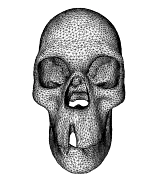
Abstract
Due to their general and robust formulation deformable models offer a very appealing approach to 3D image segmentation. However there is a trade-off between model genericity, model accuracy and computational efficiency. In general, fully generic models require a uniform sampling of either the space or their mesh. The segmentation accuracy is thus a global parameter. Recovering small image features results in heavy computational costs whereas generally only restricted parts of images require a high segmentation accuracy.
This paper presents a highly deformable model that both handles fully automated topology changes and adapts its resolution locally according to the geometry of image features. The main idea is to replace the Euclidean metric with a Riemannian metric that expands interesting parts of the image. Then, a regular sampling is maintained with this new metric. This allows to automatically handle topology changes while increasing the model resolution locally according to the geometry of image components. By this way high quality segmentation is achieved with reduced computational costs.
Type
Publication
Proc. 4th int. Conf. 3-D Digital Imaging and Modeling (3DIM'2003), Banff, Alberta, Canada. IEEE Computer Society Press
Image Segmentation
Shape Recovery
Reconstruction
Deformable Model
3D
Snake
Automated Topology Changes
Adaptive Resolution
Riemannian Geometry
Lagrangian Mechanics
Deformable Surface
Image Structure Tensor
Variational Model

Authors
Professor of Computer Science
My research interests include digital geometry, geometry processing, image analysis, variational models and discrete calculus.